
HomeStream
News & more!Escapes
My trip reviewsGallery
My travel photosPlanning
Trip planningGuides
Destination guides
My Escapes  Portugal Another Lovely Trip to Portugal! Porto Exploring Vintage Porto The Beautiful Azulejo Walls [...]
The Beautiful Azulejo Walls at the Saõ Bento Station
Rather unusually, it's not a museum that has some of the most stunning azulejo murals, nor any building destined to serve cultural purposes...
It's actually an old train station!
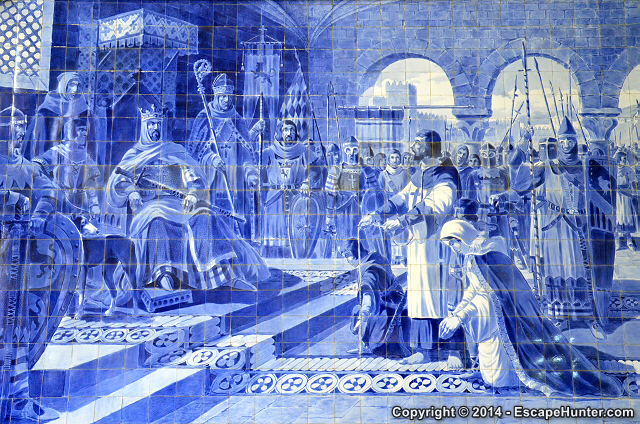
The São Bento Railway Station has an entrance hall with large blue painted styles from the early 20th century.
The azulejos depict scenes from Portugal's history.
View Photo Gallery for more travel photos
The São Bento Railway Station was built in 1916 and still serves its original purpose.
Still, the entrance hall tends to fill up with visitors coming from all over the World. It is one of Porto's main attractions.
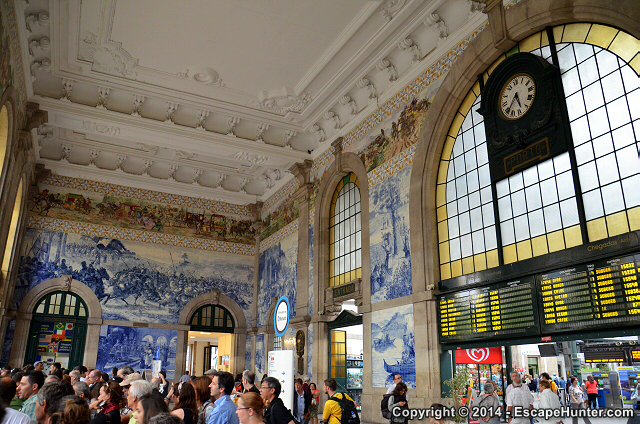
Crowds gathered for a caricature show that was undergoing in the entrance hall
View Photo Gallery for more travel photos
The name of the station comes from a Benedictine monastery's name. The 16th century religious building burned down in 1783, it was rebuilt at the end of the 19thcentury.
But, eventually this station was constructed at its spot.
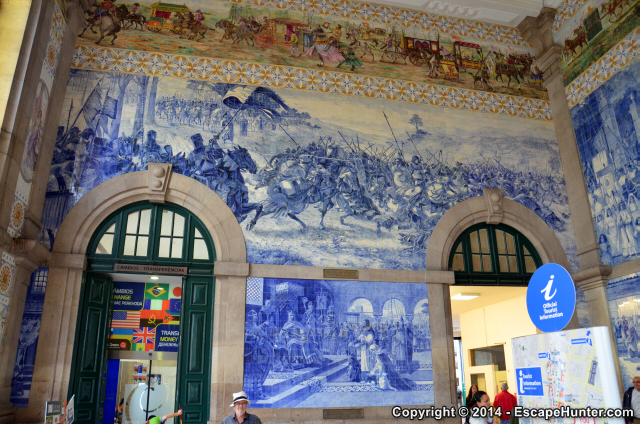
The lower levels are blue, the upper stretch of tiles is more colourful
View Photo Gallery for more travel photos
Architecturally, the São Bento station is French Beaux Arts-inspired, designed by Portuguese architect, José Marques da Silva.
But I intended this article to be about the tiles, so hopefully the photos will serve this purpose.
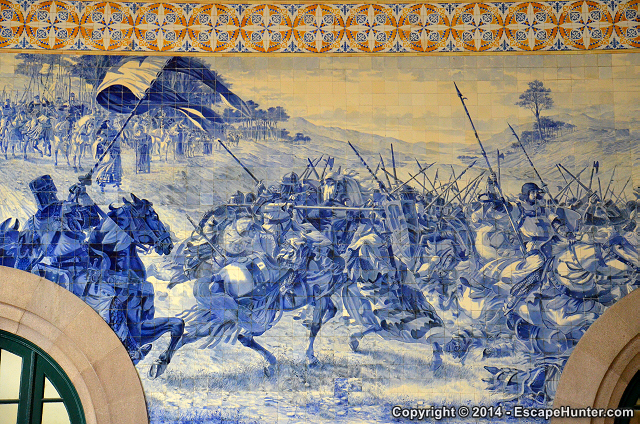
Battle scene
View Photo Gallery for more travel photos
There are 20 thousand tiles in the vestibule (hall at the entrance), dating from 1905-1916, created by Jorge Colaço, a renowned azulejo artist.
The scenes on the azulejo murals depict historical events like the Battle of Valdevez (1140), the Conquest of Ceuta (1415), they show kings and also landscapes.
Want to see more azulejos?
I recommend you to visit Porto's churches, the Azulejo Museum in Lisbon.
Otherwise, the city of Porto is indeed, one of the best places for seeing azulejos.


About the Author:
Escape Hunter, the young solo traveler in his early 30's explores the World driven by curiosity, thirst for adventure, deep passion for beauty, love for freedom and diversity.
With a nuanced, even humorous approach to travel, an obsession for art and design, Escape Hunter prefers to travel slowly, in order to learn and "soak up" the local atmosphere...
Comments


As "Escape Hunter" - the curious incognito traveler with an insatiable drive to explore, I embark on slow and deep travels around
our beautiful World.
Join me and I will show you exciting destinations
"from within", through my
"escape" trips!

Travel Slang Dictionary
Guide to my personal travel slang vocabulary, which seasons my content...
One of Portugal's kings